
Shoulder condition
Frozen shoulder
A painful tightening of the shoulder capsule that progressively limits both active and passive motion.
Frozen shoulder, or adhesive capsulitis, often begins with pain and then becomes increasingly stiff. It can arise without a clear cause or follow surgery, injury, or a period of limited use. Diabetes and thyroid disease are associated with higher risk. The condition usually improves, but recovery can be slow.
See the anatomy and imaging
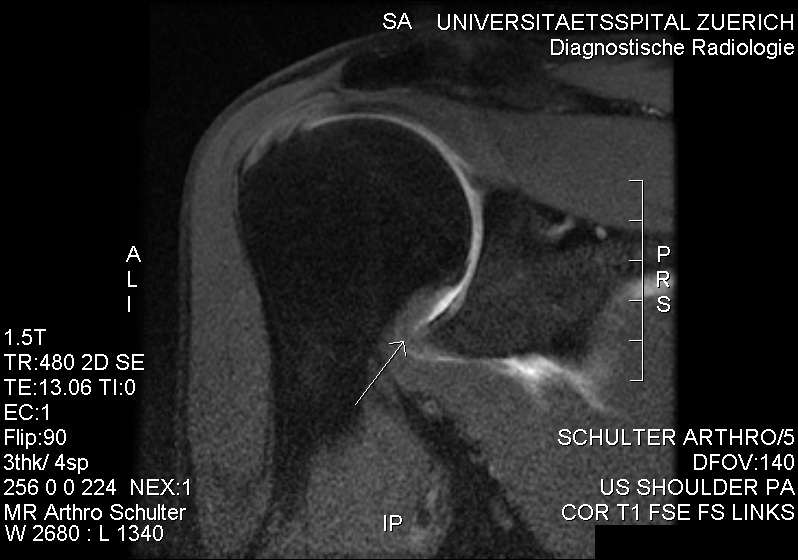
What is tightening
The capsule surrounding the ball-and-socket joint becomes inflamed, thickened, and contracted. The axillary recess and rotator interval are commonly involved. This loss of capsular volume limits rotation and elevation even when the examiner moves the arm for you.
The usual course
Symptoms often move through painful, stiff, and recovery phases over many months. The pace varies, and some patients retain meaningful stiffness without treatment. Other shoulder problems can look similar, so an examination is important.
Diagnosis
Frozen shoulder is primarily a clinical diagnosis. Examination shows a characteristic loss of passive and active motion, often with external rotation most limited. X-rays help exclude arthritis or other bone problems. MRI is usually unnecessary unless the history or examination suggests a different condition.
Treatment
- Pain control and anti-inflammatory medication when safe
- Gentle, consistent stretching and supervised therapy
- A corticosteroid injection, especially during the painful phase, when appropriate
- Capsular release or manipulation in selected refractory cases
When procedures are considered
Image-guided joint injection or hydrodilatation may be considered when pain blocks progress. Manipulation under anesthesia and arthroscopic capsular release are reserved for persistent, function-limiting stiffness after an appropriate nonsurgical course. Rehabilitation after a procedure is essential to maintain motion.
A useful distinction
Frozen shoulder restricts passive as well as active motion. A rotator cuff tear may make it hard to lift the arm actively while passive motion remains relatively preserved. Your examination and imaging help separate these problems.
Evidence and further reading
- AAOS OrthoInfo: Frozen Shoulder
- Peer-reviewed review: Adhesive Capsulitis Pathophysiology and Treatment
- Review: Treatment of Adhesive Capsulitis
Educational content is reviewed for patient clarity and is not a substitute for an examination or individualized medical advice.
PIA Shoulder MD